

Introduction
When the Lights Fell Soft and Time Stood Still: George Strait at 73 and the Night "Troubadour" Became a Prayer

There are nights in music that feel less like performances and more like moments suspended outside of time. Nights when the noise fades, the spectacle softens, and something quieter—but far more powerful—takes its place. That is what happened when George Strait, at 73, stood before a stadium filled with thousands and began to sing "Troubadour."
It did not begin with a grand gesture.
There was no need.
Because when a voice like his enters a room—or in this case, an entire stadium—it carries with it decades of memory. Not just his own, but the memories of those who have lived their lives with his music in the background. The opening lines of "Troubadour" do not demand attention. They invite it. And as those first words settled into the night air, something subtle but unmistakable shifted.
The crowd grew quieter.
Not out of obligation, but out of recognition.
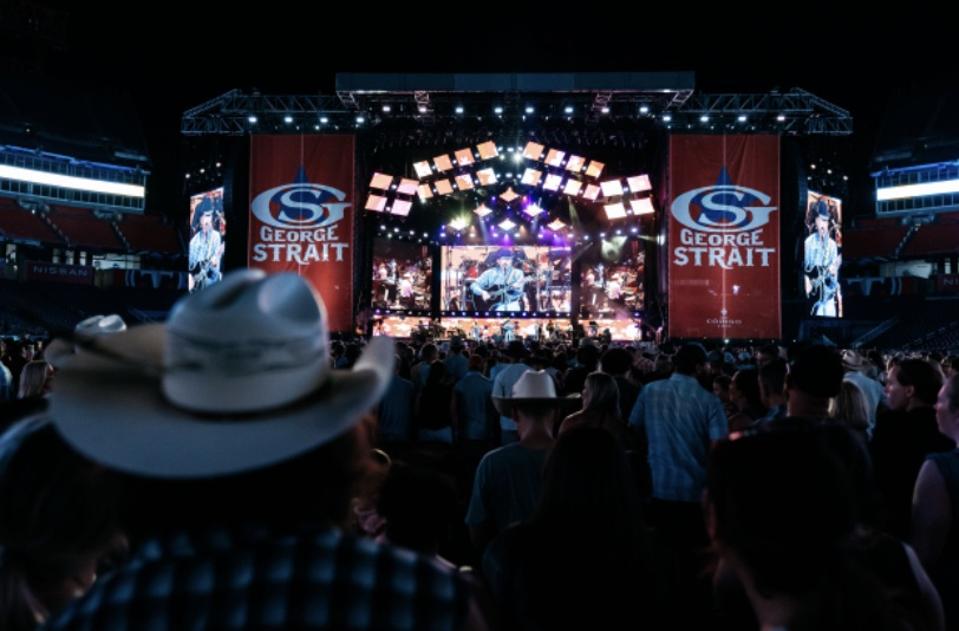
"Troubadour" has always been a different kind of song. It is not built for applause. It is built for reflection. In a catalogue filled with hits that have defined generations, this song stands apart because it speaks not to who we were, but to who we have become. It is about time—not as something lost, but as something carried.
And George Strait understands that.
At 73, he does not sing the song as a performance piece. He sings it as a lived truth. His phrasing remains steady, unforced, almost conversational. There is no attempt to dramatize the message or elevate it beyond its natural weight. Instead, he lets the song do what it was always meant to do—meet people where they are.
For older listeners, that meeting point runs deep.
It is found in the quiet acknowledgment of years gone by. In the recognition of long marriages, hard work, children grown and gone, and the quiet resilience that comes from enduring both joy and sorrow. "Troubadour" does not ask for sympathy. It offers understanding. And in doing so, it becomes something more than a song. It becomes a mirror.
As the performance unfolded, something remarkable happened in the crowd.
One by one, small lights began to rise.
Not as distraction, but as participation.
Phones lifted into the air, glowing softly in the darkness, until the stadium itself seemed to transform. What had been a vast, open space became something intimate—almost sacred. The lights flickered like candles, not in celebration, but in gratitude. It was as if each person was holding up a small piece of their own story, offering it back to the man who had unknowingly been part of it.
In that moment, the distance between performer and audience disappeared.
George Strait was not standing above the crowd.
He was standing among them.
That is the rarest kind of connection in music. It cannot be created through production or amplified through sound systems. It comes from years of trust, built slowly, one song at a time. It comes from consistency—the kind that does not chase attention, but earns it.
Throughout his career, George Strait has never relied on spectacle to define his presence. He has never needed to outshine the moment. Instead, he has allowed the moment to reveal itself naturally. And at 73, that approach has evolved into something even more meaningful: mastery without effort.
He does not reach for applause.
He allows it to find him.
And yet, during "Troubadour," applause was not the point.
The crowd did not erupt. They did not shout over the music. Instead, they listened. They sang softly, almost under their breath, as if aware that this was not a moment to be overwhelmed, but to be held carefully.
That kind of restraint says something important—not just about the artist, but about the audience.
It speaks to a shared understanding that some moments cannot be improved by noise.
They can only be honored by presence.
For younger listeners in the crowd, the performance may have felt like a glimpse into something they are still growing toward—a sense of dignity that comes with time, a way of carrying oneself that does not rely on proving anything to anyone. For older listeners, it likely felt like recognition. A quiet acknowledgment that life, with all its complexity, can still be held with grace.
That is what "Troubadour" offers.
Not answers, but acceptance.
Not finality, but continuation.
In that sea of soft light and shared memory, the truth of the moment became clear. George Strait was not performing a farewell. He was demonstrating something deeper. That legends do not disappear. They do not step away from the stories they have helped shape. Instead, they learn how to stand within those stories differently—more quietly, more reflectively, but no less powerfully.
"Troubadour" is, in many ways, a song about time's passage.
But on that night, it felt like something else entirely.
It felt like time standing still.
And perhaps that is the true measure of a moment like this. Not how loud it becomes, but how deeply it settles. Not how quickly it fades, but how long it stays.
Long after the lights were lowered and the final notes drifted into silence, what remained was not just the memory of a performance.
It was the feeling of having been part of something rare.
A night when a stadium became a sanctuary.
And a song became a prayer.