

Introduction
🔥 SHOCKING REVELATION: THE NIGHT Elvis Presley BROKE DOWN IN TEARS — A FINAL CONFESSION HIDDEN IN A SONG
There are nights in music history that feel almost sacred—moments when performance dissolves into something deeper, something unguarded. And then there are nights that seem to hover on the edge of confession, where the line between artist and man disappears entirely. One such night, whispered about in hushed tones among those who were there, unfolded in early 1977—just months before the world would lose Elvis Presley forever.
It was not a concert. There were no flashing lights, no roaring crowds, no spectacle worthy of "The King." Instead, there was only a dimly lit studio, a piano, and a man carrying the invisible weight of years—years of fame, expectation, and quiet personal battles that had never quite found their voice.
By then, Elvis was no stranger to the stage. From the explosive energy of the 1968 Comeback Special to the global triumph of Aloha from Hawaii via Satellite, he had long proven that he could command not just a room, but the world. Yet what unfolded that February night was not about commanding anything. It was about surrender.
For hours, those present watched him move through take after take of "Unchained Melody." Technically, everything was there—the phrasing, the control, the unmistakable timbre of a voice that had defined generations. But something was missing. Not in the notes, but in the soul behind them. Elvis seemed restless, unsatisfied, as though he were searching for something he could not quite reach.
Then, quietly, he spoke: "Turn off the lights."
What followed was not rehearsed. It was not refined. It was not safe.
Under a single, fragile spotlight, he began again.
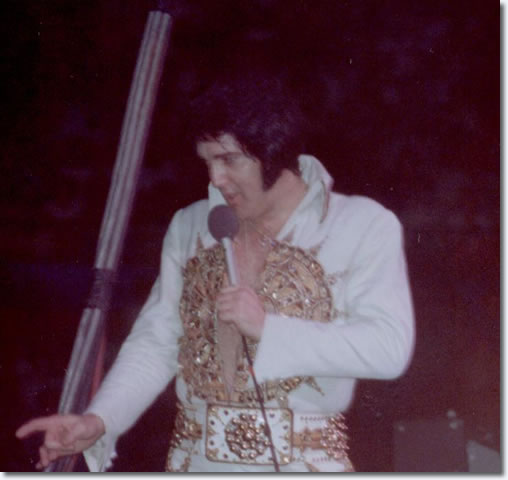
The first line emerged, but it did not glide—it trembled. His voice cracked, not in the polished way of a performer bending emotion to his will, but in the raw, involuntary way of a man whose guard had finally given way. It was the kind of imperfection most artists would fight to hide. Elvis did not hide it. He leaned into it.
And then came the moment no one in that room would ever forget.
He broke.
Not subtly. Not with restraint. But completely.
Tears streamed down his face as he sang, each word no longer part of a song but part of something far more personal. "Unchained Melody" ceased to be a love ballad; it became a quiet reckoning. A reflection. Perhaps even a farewell.
Those watching—seasoned musicians, close friends, men who had stood beside him through decades of triumph—were left motionless. Some lowered their heads. Others wiped away tears they did not expect. No one dared interrupt. No one could.
Because what they were witnessing was not simply music.
It was truth.
When the final note faded, there was no applause. Only silence. A silence so complete it seemed to carry its own weight. In that stillness, everyone understood—this was not something that could be recreated, polished, or improved. It was, in its imperfection, complete.
That recording—fragile, cracked, and achingly human—would later be remembered as one of the most haunting moments of Elvis's final chapter. Not because it showcased his power, but because it revealed his vulnerability.
And yet, what happened after may be even more telling.
Later that night, long after the studio had emptied and the echoes of that performance had settled into memory, Elvis made a phone call. It was not to a producer, not to a manager, not to anyone connected to his career.
He called Priscilla Presley.
There were no formalities. No small talk. No attempt to explain the weight of the evening.
Only two words.
"I'm sorry."
In that moment, the man who had once seemed larger than life—untouchable, immortal in the eyes of millions—was reduced to something infinitely more relatable. A man reflecting on the choices behind him. A man aware, perhaps, that time was no longer something he could take for granted.
Just months later, the world would mourn his passing. And in the wake of that loss, moments like that February night took on a different meaning. What once might have been seen as a flawed performance became something else entirely—a message.
A goodbye hidden within a melody.
A confession carried not through conversation, but through song.
For those who have listened closely in the years since, that rendition of "Unchained Melody" does not feel like an ending in the traditional sense. It feels like a window—brief, unguarded—into the heart of a man who gave the world everything he had, even when he had little left to give.
And perhaps that is why it still resonates so deeply, especially with those who understand that life, like music, is not measured by perfection. It is measured by honesty.
In the end, Elvis Presley did not leave behind just a legacy of hits or headlines. He left behind something quieter, but far more enduring: the reminder that even the greatest voices can tremble… and that sometimes, it is in that trembling where the truest song is found.
Because on that cold night in 1977, the world did not just hear a legend sing.
It almost heard his heart break.
Video